13-15 September 1999, Hong Kong Convention & Exhibition
Centre

'IP, phone home'
ECMS, (c)-tech, and protecting privacy
against surveillance by digital works
Graham Greenleaf
Professor of Law
University of New South Wales
Australia
http://www2.austlii.edu.au/~graham
g.greenleaf@unsw.edu.au
Abstract
The development of copyright-protective technologies ('(c)-tech') and electronic
copyright management systems ('ECMS'), despite their benefits to rights-hoiders,
pose many dangers to the protection of privacy, which some have said could
mean an end to the privacy of reading. This paper explores these potential
dangers, and possible remedies. How should (c)-tech and ECMS protect privacy
interests? How do existing data protection and privacy laws affect the
operation of (c)-tech and ECMS? Do laws against copyright circumvention
devices and interference with rights management information (RMI) prevent
privacy protection?
Version
This is the first version (26 June 1999) of a work-in-progress, prepared
for the 21st International Conference on Privacy and Personal Data Protection,
Hong Kong 13-15 September 1999. This and subsequent versions may be found
at http://www2.austlii.edu.au/~graham/publications/ip_privacy/
INTRODUCTION - INFORMATION WANTS...
"Information wants to be free"[1]
is one of the 'myths of digital libertarianism'[2]
that formed the ideology of the pre-commercial Internet. Digital libertarians
expected intellectual property law to be one of the first casualties of
cyberspace, because the process of digitisation of works made them infinitely
reproducible at virtually no marginal cost and infinitely distributable
via the Internet. The Internet and property in information were widely
believed to be incompatible, and technology would win against law and set
information free. `Everything [you know] about intellectual property is
wrong' claimed John Perry Barlow[3].
The reverse process is now underway: technical protections of intellectual
property over networks may protect property interests in digital works[4]
more comprehensively than has ever been possible in real space, and destroy
many public interest elements in intellectual property law in the process.
In the worst scenarios, the surveillance mechanisms being developed to
do this may also bring about the end of the anonymity of reading.
As Lessig observes, infinite copies could only be made if "the code
permits such copying", and why shouldn't the code be changed to make such
copying impossible'[5]?
It has only taken a few years for intellectual property to become one of
the most controversial areas where cyberspace architecture is said to be
replacing law as the most effective method of protection, due to the emergence
of copyright-protective technologies (hereinafter '(c)-tech') and electronic
copyright management systems (hereinafter 'ECMS').
This paper explores what protections are found in information privacy
laws against surveillance by digital works, and the extent to which privacy
laws need to be strengthened to help provide a reasonable balance between
privacy and the protection of intellectual property. Some specific questions
are addressed:
-
What are the privacy dangers in (c)-tech and ECMS?
-
How should (c)-tech and ECMS protect privacy interests? Do they?
-
Do laws against copyright circumvention devices and interference with rights
management information (RMI) prevent privacy protection?
-
How do existing data protection and privacy laws affect the operation of
(c)-tech and ECMS?
This paper aks whether we have only received a fragment of Brand's aphorism[6]:
is it really `Information wants to be free ... but it wants to keep you
under surveillance' ?
ANONYMITY AND PRIVACY - TRADITIONAL IP RIGHTS
We should start with a reminder of some of the ways in which intellectual
property laws and enforcement practices have traditionally respected privacy,
so as to appreciate better what changes are inherent in new laws and practices.
Here are some common, though not universal, features:
-
Most sales of artefacts embodying copyright works (books, CDs, videos etc)
were anonymous because they were cash transactions, with payment by identified
means at the option of the purchaser.
-
Users of copyright artefacts did not usually enter into any contractual
relationship with the owner of the copyright, as they dealt only with intermediaries
(booksellers, record stores, libraries etc). This is why copyright was
needed as a property right, since contract was inadequate protection.
-
The artefacts had no inherent surveillance capacities. They would not record
(much less, communicate) who had used them, when or where.
-
Copyright law did not give copyright owners a general right to control
uses of artefacts embodying their works, other than the specified 'infringing
uses' which involved 'copying' and a limited number of forms of communication.
Consequently, who read a book (or watched a film), how often, when
and where was generally none of the author's business.
-
Loans of copyright artefacts to others to use were generally beyond the
control or knowledge of copyright owners. Where intermediaries such as
libraries or video rental stores did keep records of borrowings, these
could result in privacy invasions, but usually not by or for the copyright
owners.
-
Enforcement of copyright - detection of and action against infringing uses
- was therefore not a by-product of routine surveillance of all uses of
copyright works, but usually a matter of selective surveillance and periodic
detection (ex post facto). Enforcement in 'real time' (simultaneous with
attempted infringement) was generally impossible.
-
There were various types of 'fair use' of copyright artefacts (uses which
would normally constitute infringements but under certain conditions did
not) which did not require the user to seek any licence from the copyright
owner or even communicate to the copyright owner that the use was taking
place. 'Fair use' could also be private use.
-
Some types of infringement would only occur where the act concerned was
'in public' (or some similar formulation), effectively creating various
types of 'private spheres' outside the scope of copyright laws[7].
Although these exceptions to copyright for 'private use' are the most obvious
form in which copyright law accommodated privacy, it is a mistake to exaggerate
their importance[8].
In comparison, the default condition of anonymity in the normal use of
copyright artefacts is more important.
The above description was largely true in relation to the 'end users' of
copyright artefacts, consumers, but was less true of various categories
of intermediaries who licensed the uses of copyright works.
THE NETWORKED WORLD OF DIGITAL ARTEFACTS
Kevin Kelly in 'New Rules for the New Economy'[9]
thinks 'the trajectory is clear. We are connecting all to everything.':
As we implant a billion specks of our thought into everything
we make, we are also connecting them up. Stationary objects are wired together.
The nonstationary rest - that is, most manufactured objects - will be linked
by infrared and radio, creating a wireless web vastly larger than the wired
web. It is not necessary that each connected object transmit much data.
A tiny chip plastered inside a water tank on an Australian ranch transmits
only the telegraphic message of whether it is full or not. A chip on the
horn of each steer beams out his pure location, nothing more: "I'm here,
I'm here." The chip in the gate at the end of the road communicates only
when it was last opened: "Tuesday."
Surveillance of what we do via the artefacts that we own or use is a much
broader privacy issue than (c)-tech. Some of the earliest examples have
little to do with intellectual property, but often have to do with protection
of physical property or of other forms of revenue streams. Here are some
examples that are rather more privacy-sensitive than Kelly's, but are not
primarily about protecting intellectual property:
-
Intel planned to put a machine-specific ID in every Pentium III processor
chip, to allow merchants and other "trusted" parties to establish a person's
identity (correlated with their machine ID) over networks, and ostensibly
to prevent stolen PCs from getting on the Internet[10].
From the intended uses, it is fairly clear how broad the 'unintended' ones
could have turned out to be. Intel intended to supply chips with the ID
number feature turned on in default, but with a software patch theoretically
available for those knowledgeable and persistent enough to wish to protect
their privacy - the usual 'opt out' sop. Intel said they would not be keeping
a database matching users to their ID numbers - worthless assurances, as
they could not control manufacturers of PCs with their chips, or large
organisations distributing PCs to users. After a storm of user protest
and threatened legislation, Intel said it would turn off the feature by
default for remaining unsold chips, converting it to 'opt in'.
-
An Australian ISP recently stopped accepting any dial-ins except from lines
that had caller-ID enabled. The ISP claimed it could therefore avoid billing
disputes, but the effect on privacy is to make surveillance of dialing
location a condition of ISP use.
-
Microsoft was forced to change its Windows 98 Registration Wizard after
it was shown to be sending a specific hardware identifier to Microsoft
without user consent[11].
-
The following week, Microsoft's Office 97 was shown to include a secret
unique identifier (derived from the user's network card) in all documents
created with a particular copy. Microsoft claimed that this could not 'reliably'
identify the author of a document[12]
- a rather unconvincing evasion.
There is a trend here: artefacts that report back through digital networks
to some central monitoring point about their location, current state, or
prior usage, often in a way which allows that information to be correlated,
more or less reliably, with the actions of individual people. It is also
a common tactic of the computer industry is to secretly build artefacts
with surveillance capacities enabled in default (at best with some 'opt
out' kludge) and hope they get away with it. Whether this is worse in the
dominant American part of the industry, where developers face relatively
few legislative constraints, deserves to be explored.
If artefacts in general are rushing headlong toward interconnection
through networks, we might expect to see this reflected fairly early in
digitised works. To see that digital artefacts do live in a networked world
is simple enough. Many people now work in offices (or homes) with Internet
connections active whenever they are using their computers. This means
that every program, document or other file on their computer is (in theory)
capable of communicating with anywhere else on the Internet, such as the
computer system of its copyright owner or of an intermediary in an ECMS.
Furthermore, many digital artefacts have their full utility only when we
are online. An obvious example is that word processing documents are now
created routinely with live hypertext links, so that the document is interactive
if opened when the user's PC is online, but not otherwise. The telecommunications
infrastructure for digital artefacts to exercise surveillance is therefore
present, and many of us are increasingly making that infrastructure active
whenever we are at a computer.
Our rights to limit surveillance via artefacts will be one of the key
privacy issues for the start of the next century, and digital works are
likely to be one of the most contentious examples.
TECHNOLOGIES AND SYSTEMS FOR COPYRIGHT PROTECTION
There are a wide variety of particular technologies and products which
can be used to protect digital works (hereinafter '(c)-tech'). We need
to distinguish them from systems of copyright protection which are
built around one or more of these technologies and involve particular sets
of participants (an 'electronic copyright management system' or ECMS).
Copyright-protecting technologies
The variety of (c)-tech[13]
is summarised[14]
below in approximate order of their implications for privacy:
-
Works in a central location, which require a password or some other form
of identification before they can be accessed.
-
Cryptographic `containers' which allow copies of works to be distributed
widely but only used in full once a key has been obtained[15],
or use other metering methods restricting use without further payment ('superdistribution'[16]).
-
Digital watermarks (and other forms of steganography) which embed irremovable
(and sometimes undetectable) information about rights holders and/or licensees
in each copy of the work.
-
Digital works which 'refuse' to allow actions which breach the licence
conditions of that particular copy of the work (Stefik's 'trusted systems').
-
'Trusted printing', where a work will not print (or otherwise copy) unless
payment is first made for the copy, the work is sent to the 'printer' in
encrypted form, and the copies are watermarked in some way. These are part
of 'trusted systems'.
-
Works that cease to be usable after the expiration of a licence or breach
of licence conditions, or until a further licence is obtained.
-
Systems for "detecting, preventing, and counting a wide range of operations,
including open, print, export, copying, modifying, excerpting, and so on"
(part of IFRRO's description of an ideal system).
-
Use of existing internet search engines to search for infringing copies
of works, using normal text searching techniques.
-
Customised web spiders that routinely trawl the web for information identifying
digital works (eg digital watermarks and other identifiers). Such web spiders
are in use[17]
by Broadcast Music Inc (BMI) and by Digimark, a photo watermarking company
acting on behalf of clients such as Playboy.
-
Works that record details of when they are used (including breaches of
licence conditions). IFRRO's ideal system "captur[es] a record of what
the user actually looked at, copied or printed".
-
Works that, whenever they are online, send reports back to a central location
online concerning when are used or copied, including to obtain 'permission'
to do so ("IP phone home"). IFRRO's ideal system sends "this usage record
. . . to the clearinghouse when the user seeks additional access, at the
end of a billing period or whenever the user runs out of credit."
This is an unsystematic and incomplete list of illustrations.
Although there are a bewildering variety of techniques and products
that we could classify as (c)-tech, most seem to combine a few basic elements:
-
Access controls - Controlling access to a work may be as simple
as requiring a password or only accepting http requests that come from
particular sub-domains, or it may require authentication of the enquirer
by a digital signature. Where copies of works are distributed, each copy
may require a separate encryption key to access it (eg 'cryptolopes').
Works may be such that they 'refuse' to allow various forms of use (printing,
'cut and paste', use beyond a certain date etc) unless certain conditions
are met. These are more sophisticated forms of access control.
-
Identification in the work - There are many techniques for embedding
meta-information in the work itself, and many types of information embedded,
from static information identifying the work, its licensee or licence conditions,
to dynamic information that is updated as the work is used.
-
Surveillance - Whatever technologies are used, rights owners (or
intermediaries representing them) often need to some form of active surveillance
of access to and use of the work, either in order to utilise their rights
under copyright law, or for the digital work to execute its own remedies
(eg 'refusing' to operate), or to grant or refuse licences. The information
needed is typically stored in the work itself, but the rights-owner must
access it either through 'pull' methods (eg search engines and web spiders)
or 'push' methods (eg cookies and other means of sending data back to a
central point).
Electronic Copyright Management Systems (ECMS)
Individual (c)-tech are important, but they are not the key element in
the cyberspace architecture that is being developed to protect intellectual
property. What may make architecture replace law as the principal protection
of digital works is a common framework for the trading of intellectual
property rights, both between businesses and to end-users, a set of standards
within which all of the particular (c)-tech can work.
An Electronic Copyright Management Systems (ECMS) may take many forms.
The 'ideal aims' of an ECMS have been described (in a formulation more
sympathetic to consumer and privacy rights than most product descriptions)[18]
as follows:
* provide copyright-protected material to users upon request;
* provide a means for remuneration (or a facility to grant or refuse
a licence) to flow to the owner;
* track usage of material (which documents, how often, used by whom
and so on) without interfering with the privacy of the user;
* prevent unlawful appropriation of the copyright material by people
who are outside the system;
* prevent unlawful use of the copyright material by users who obtain
the material legitimately in the first instance;
* ensure the integrity of the intellectual property;
* allow for a reasonable flow of information between owners to users
(owners are often also users and vice versa) in the public interest (that
is, an ECMS should not unreasonably tie up the community's information
and cultural resources); and
* allow for the effective operation of fair dealing within the ECMS.
The potential for privacy intrusions is apparent from the third, fourth
and fifth aims, even in this 'ideal' description.
Example of an ECMS model - The Imprimatur Project
In Europe the Imprimatur project[19],
sponsored by the European Commission, developed the Imprimatur Business
Model. Bygrave and Koelman describe the actors and inter-relationships
in the model [20]:
In brief, the role of the creation provider (CP) is analogous
to that of a publisher; ie, he/she/it packages the original work into a
marketable product. The role of the media distributor (MD) is that of a
retailer; ie, he/she/it vends various kinds of rights with respect to usage
of the product. The role of the unique number issuer (UNI) is analogous
to the role of the issuer of ISBN codes; ie, it provides the CP with a
unique number to insert in the product as microcode so that the product
and its rights-holders can be subsequently identified for the purposes
of royalty payments. The role of the IPR database provider is to store
basic data on the legal status of the products marketed by the MD. These
data concern the identity of each product and its current rights-holder.
The main purpose of the database is to provide verification of a product's
legal status to potential purchasers of a right with respect to usage of
the product. As such, the IPR database is somewhat similar in content and
function to a land title register. The role of the monitoring service provider
(MSP) is to monitor, on behalf of creators/copyright-holders, what purchasers
acquire from MDs. Finally, the certification authority (CA) is intended
to assure any party to an ECMS operation of the authenticity of the other
parties whom he/she/it deals. Thus, the CA fulfils the role of trusted
third party (TTP).
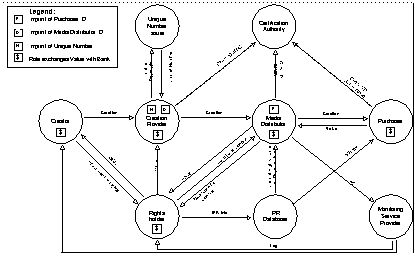
Figure - Imprimatur Business Model (Version 2.0)
[21]
From this brief description, some fundamental changes to the way in
which copyright currently operates can be noted:
-
Each digital work is issued with a unique identification number[22],
which is then inserted by the content provided as microcode in the work
to enable it to be tracked in various situations. See below concerning
the range of identification systems emerging.
-
There is an IPR database, `somewhat similar in content and function to
a land title registry', enabling anyone (particularly potential purchasers)
to verify a digital work's ID and legal status.
-
There is a monitoring service provider (MSP) which, on behalf of creators
and rights holders, will (though the summary does not say this) monitor
transactions, uses and breaches (depending on the technology) of rights
in digital artefacts. MSPs will use a variety of mechanisms, including
reporting from Media Distributors, and surveillance of the web through
the use of search engines, customised web spiders, and digital artefacts
that report on their own usage.
-
Certification Authorities (CAs) play a major role, as it assumed that both
parties to transactions, and the authenticity of communications from them
will be routinely identified by digital signatures, and so verification
by CAs is needed.
This blueprint for the architecture in which intellectual property transactions
will operate in cyberspace could hardly be more different than the real
space architecture in which IP operates at present. As regulation, this
code shares few similarities with IP law. This is not necessarily a criticism,
merely an observation of how powerful and different architecture as regulation
will be in intellectual property.
Standards and pervasiveness
The success, importance and danger of ECMS is likely to depend in large
part on the extent to which they achieve interoperability between multiple
publishers (within one ECMS), and ultimately, between different ECMS and
different media types.
One of the key standards is for identification of digital works.
Gervais[23]
describes eleven competing standards, including a variety of media-specific
identifiers, and more general proposals such as the Digital Object Identifier
(DOI) and Persistent Uniform Resource Locators (PURLs). He also describes
five standards for metadata[24]
that (in the absence of one global identification system for digital works
emerging) might provide a basis for interoperability between ECMS based
around different numbering systems. DOI and PURL also have potential for
unifying differing numbering systems without replacing them.
This Babel of IDs for digital works is as yet slowing down the
development of ECMS, and buys a limited amount of time for privacy protection
to be developed.
PRIVACY ISSUES IN (C)-TECH AND ECMS
The amount of online surveillance of users of digital works may become
unacceptable, compared with the ways in which we use intellectual property
in real space.
Bygrave and Koelman, while not opposed to ECMS, stress that the
surveillance dangers are one of the most significant obstacles to their
acceptable operation:
... such systems could facilitate the monitoring of what people
privately read, listen to, or view, in a manner that is both more fine-grained
and automated than previously practised. This surveillance potential may
not only weaken the privacy of information consumers but also function
as a form for thought control, weighing down citizens with "the subtle,
imponderable pressures of the orthodox", and thereby inhibiting the expression
of non-conformist opinions and preferences. In short, an ECMS could function
as a kind of digital Panopticon. The attendant, long-term implications
of this for the vitality of pluralist, democratic society are obvious.
Julie Cohen, speaking mainly of the IFRRO's notion of an ideal ECMS, concludes:
These capabilities, if realized, threaten individual privacy
to an unprecedented degree. Although credit-reporting agencies and credit
card providers capture various facets of one's commercial life, CMS raise
the possibility that someone might capture a fairly complete picture of
one's intellectual life.
Reading, listening, and viewing habits reveal an enormous amount about
individual opinions, beliefs, and tastes, and may also reveal an individual's
association with particular causes and organizations. Equally important,
reading, listening, and viewing contribute to an ongoing process of intellectual
evolution. Individuals do not arrive in the world with their beliefs and
opinions fully-formed; rather, beliefs and opinions are formed and modified
over time, through exposure to information and other external stimuli.
Thus, technologies that monitor reading, listening, and viewing habits
represent a giant leap--whether forward or backward the reader may decide--toward
monitoring human thought. The closest analogue, the library check-out record,
is primitive by comparison. (And library check-out records are subject
to stringent privacy laws in most states. (footnotes omitted)
Gervais, a proponent of ECMS, emphasises the crucial role that ECMS intermediaries
(such as MSPs and CAs in the Imprimatur model) will have in the protection
of privacy:
An electronic copyright-management system does not in and by
itself protect privacy, but it is probably the best tool to do so. If the
rules under which the electronic copyright-management system operates are
correctly designed, the system would return to rights holders aggregated
information on use of his/her works. For example, the system could say
that clearance was granted to use "Scientific Article X" to "11 pharmaceutical
companies in the last month", or that "2,345 users in this part of Chicago"
downloaded a given musical work. The rights holder thus gets market data
without violating anyone's confidentiality or privacy. Even now the Copyright
Clearance Center in the U.S. does not report to rights holders which articles
from medical or scientific journals are used by individual users (e.g.,
pharmaceutical companies). It only tells rights holders how often a work
was used by, say, the pharmaceutical industry as a whole. Most collective
management organizations aggregate information in this way and this is
perhaps a function whose value has thus far been underestimated by users.
Gervais identifies the role of pseudonymity in the proper operation of
ECMS:
A related issue is how to identify individual digital copies
(which presumably have been sold to a specific user), without creating
a risk to privacy or confidentiality. If indeed individual copies are identified,
using a watermark containing a transaction code for instance, a viable
solution could be to number individual copies, without including data identifying
the user who "ordered" the copy in question. Copy numbers could be linked,
in a secure database, to the individual users. Should there be a good reason
to make the link between the copy number and the user -- for instance,
under court order -- that link could be made. The role of trusted third
parties acting as aggregators of usage data might be especially important
to users. An aggregator or collective management organization using an
electronic copyright-management system could thus maintain the confidentiality
of the link (if any) between a given copy delivered on-line and a specific
user. The content owner would receive with the payment for use of his works
a report on the number of uses, possibly with an indication of the type
of users concerned, but no information about individual users. Without
this type of confidentiality guarantee, it may be very difficult for electronic
copyright commerce to prosper. In other words, properly tuned electronic
copyright-management systems that aggregate data so as to protect privacy
and confidentiality are probably essential ingredients of the success of
electronic copyright commerce.
Many other examples may be given of the role that such intermediaries can
play in protecting privacy. Researchers (or lawyers) do not want anyone
to know what digital works they are consulting. An author wanting permission
to include an extract in an anthology or other collection does not want
her publishing plans indirectly disclosed to rival publishers.
Many (c)-tech can be and will be used without any intermediaries between
the end-user of a digital work and the rights-holder. 'Disintermediation'
is still one of the buzzwords of Internet business models. In its positive
incarnations we think of recording artists or authors being able to sell
directly to
their publics. Just as likely, publishing houses of
various sorts (still the rights-holders) will do a far greater percentage
of direct selling to
the public without the use of intermediaries
such as booksellers (Amazon excepted!). The result is likely to be a mixture
of delivery models, but the point is that a lot of (c)-tech and ECMS will
be run directly by publishing houses with lots of different products to
shift and a strong interest in secondary use of identified consumption
data. We will not always be 'lucky' enough either to have some central
industry-based monitoring body standing between consumers and publishers,
or to be dealing direct with the artist.
Without attempting to catalogue the issues at this point, it seems
that privacy protection in relation to (c)-tech and ECMS must have multiple
aims. First, there is a need to maximise the use of (c)-tech which allows
fully anonymous transactions involving digital works, provided that in
doing so we don't create worse problems of unfair contract enforcement
(see below). Second, where it is necessary for transactions to be identifiable,
pseudonymity should be used wherever possible to prevent the misuse of
personal information for secondary purposes, and also to prevent a 'chilling
effect' on freedom to read, think and speak.
Other issues in ECMS - 'fair use' and fair enforcement
Privacy is not the only issue raised by ECMS, nor perhaps even the most
important one. The architecture of ECMS need not observe any of the public
interest limitations built in to copyright law. These include the right
to lend a work for use by others (the basis of libraries - the `first sale
doctrine'), and the various `fair dealing' rights to copy works or parts
thereof for purposes such as `criticism and review' or `private study and
research'. As Lessig puts it "what the law reserves as an limitation on
the property holder's rights the code could ignore"[25].
If dealings in relation to digital works become direct transactions where
it is practical for the rights-owner to enter into a contract with the
user (unlike the purchase of a book in a store), then such contracts are
likely to routinely exclude such public interest exceptions.
The enforcement of such contracts is also unlike real space contracts,
Lessig points out[26],
because whereas the law always takes into account various public and private
interests in determining the extent and means by which contracts will be
enforced, when contracts are self-enforced by code (for example, by the
work suddenly becoming unusable) these public values are not likely to
be taken into account. We might add that when the law enforces a contract
there is an independent assessment of whether there has been a breach of
the contract, whereas here the enforcement is automated and unilateral,
built into the architecture. If `code contracts' replace law, these are
not necessarily the same as `law contracts', and may not be in the public
interest.
Are ECMS addressing privacy issues?
It is difficult to the sure to what extent those who are developing ECMS
are taking privacy issues seriously. A list of over 30 ECMS projects[27]
does not contain any with privacy policies explicitly listed on their web
sites, though this may sometimes be because their proposed operations are
not privacy-sensitive. However, it is surprising not to find easily accessible
privacy policies on such major sites as Open Market's SecurePublish[28]
(a Folio product) or Copyright Clearance Center[29].
It would be helpful (and probably reassuring) if major players in (c)-tech
and ECMS had easily accessible privacy policies concerning the use of their
products and services. Imprimatur commissioned the valuable Report by Bygrave
and Koelman, but research on privacy implications by other promoters is
hard to find.
The Propagate project[30],
Australia's equivalent to Imprimatur, held its first Consensus Forum (August
1998) with the aim of developing 'consensus' within the Australian `rights
community' on development of ECMS standards for all media types in Australia.
Most collecting societies and other rights-holder organisations attended,
but there was little representation of the users of copyright works, or
of the broader public interests that copyright serves. As Lessig puts it
`once it is plain that code can replace law, the pedigree of the codewriters
becomes central'. This 'consensus' approach, though valuable, is not genuinely
representative of the interests affected. The discussions at the Forum
showed a lively sensitivity to privacy considerations, and recognition
of the value of anonymous and pseudonymous transactions, but there fewer
ideas on how to accommodate the `fair dealing' issues mentioned above.
LAWS AGAINST CIRCUMVENTION OF COPYRIGHT PROTECTION
The WIPO Copyright Treaty 1996 (WCT) requires contracting parties
to provide legislative prohibitions against copyright circumvention devices
and against the removal of 'rights management information' (RMI). These
are the first legislative protections given to (c)-tech and ECMS, by the
negative device of preventing their circumvention. Although phrased in
terms of protecting an author's statutory rights, they may turn out to
be of broader significance as one of means by which authors can protect
an expanded set of rights through a combination of contracts and surveillance.
This is law facilitating surveillance: 'data surveillance law'.
Article 11 provides, in relation to copyright circumvention devices:
`Contracting Parties shall provide adequate legal protection
and effective legal remedies against the circumvention of effective technological
measures that are used by authors in connection with the exercise of their
rights under this Treaty or the Berne Convention and that restricts acts,
in respect of their works, which are not authorised by the authors concerned
or permitted by law.'
Article 12 of the WCT provides, in relation to 'rights management information':
(1) Contracting Parties shall provide adequate and effective
legal remedies against any person knowingly performing any of the following
acts knowing, or with respect to civil remedies having reasonable grounds
to know, that it will induce, enable, facilitate or conceal an infringement
of any right covered by this Treaty or the Berne Convention: (i) to remove
or alter any electronic rights management information without authority;
(ii) to distribute, import for distribution, broadcast or communicate to
the public, without authority, works or copies of works knowing that electronic
rights management information has been removed or altered without authority.
(2) As used in this Article, `rights management information' means information
which identifies the work, the author of the work, the owner of any right
in the work, or information about the terms and conditions of use of the
work, and any numbers or codes that represent such information, when any
of these items of information is attached to a copy of a work or appears
in connection with the communication of a work to the public.
From the perspective of privacy protection, some of the questions we need
to ask about these provisions and their national legislative implementations
are:
-
Can you delete from digital works personal information that facilitates
surveillance?
-
Can you prevent a web robot from looking for infringing artefacts?
-
Can you prevent a digital work from communicating information over the
Internet?
National implementations of the WCT are what is crucial, and they may go
beyond what it requires. In the following sections, we will take Australia
as an example of implementation. The United States Digital Millenium
Copyright Act of 1998 has amended Title 17 of the US Code (dealing
with copyright) to implement the WCT. Where the US has taken a different
approach to protection of privacy, this is noted but not analysed in detail.
Example - Australia's 'Digital Agenda' Bill
The Australian Government intends to ban commercial dealings in circumvention
devices and to ban removal of copyright information (`rights management
information') electronically attached to copyright material' [31]
. A draft Copyright Amendment (Digital Agenda) Bill 1999 has been
given a first reading in Parliament.
Circumvention devices
The Bill draws heavily on the proposed EC Directive[32],
and so is of interest as a comparative implementation of the Directive
as well as of the WCT. It is a breach of copyright where a person makes,
sells, imports or otherwise deals with[33]
'a circumvention device[34]
capable of circumventing, or facilitating the circumvention' of 'effective
technological protection measures', if they knew or were reckless as to
whether it would be used for this purpose and for the purpose of infringing
copyright (s116A). The onus of proof rests on the defendant. Where s116A
applies, the copyright owner has the same remedies against the person responsible
for the circumvention device as in relation to any infringements of copyright
as take place.
There will also be a criminal offence where the same conditions
as in s116A are satisfied, but with a higher burden of proof and the onus
of proof on the Crown (added to s132). A similar offence is created in
relation to the operation of a 'circumvention service'[35].
The Australian legislation is principally interesting from a privacy
perspective because of its limited scope:
-
Actual use of a circumvention device is not proscribed, only making
and dealing in such devices. Nevertheless, a question remains as to whether
a person who writes his or her own small piece of software in order to
prevent some surveillance device operating as it is intended might be regarded
as 'making' a device.
Provision of a 'circumvention service' is a criminal offence, but
it is not an offence (or an infringement) simply to use such a service.
An ISP would have to consider whether it was providing 'circumvention services'
to those whose content it hosts or to whom it provides access.
-
While the definition of 'technological protection measure'[36]
is broad, only 'effective technological protection measures'[37]
are protected, and these are limited to measures where 'access to the work
or other subject-matter ... is available solely by use of an access code
or process (including decryption, de-scrambling or other transformation
of the work or subject-matter) with the authority of the owner of the copyright
in the work or subject-matter. The Bill will protect the use of (c)-tech
aimed at access limitation such as 'crypto-bottling' of works (where access
depends on use of a particular decryption key) or the simple device of
providing on-line (or CD-ROM) access only by password. Technologies to
make digital artefacts expire after use or after a period could also be
protected here.
It is a possible that a digital artefact resident on a user's PC
which could not be accessed unless there was first an online check back
to the copyright owner's database that the licence was still valid ('IP,
phone home') could be regarded as an 'access ... process' protected by
this provision. If so, one of the most far-reaching forms of surveillance
by and of digital works will be protected. The important thing to note
is that circumvention will be illegal irrespective of whether the personal
information which is collected is used for secondary purposes (eg marketing)
which have nothing to do with copyright protection, and whether or not
normal privacy protections in the collection of personal information have
been observed (see the next section). In short, anti-circumvention provisions
are applicable irrespective of privacy breaches, and they should not be.
The US
Digital Millenium Copyright Act provides an explicit defence
agains its anti-circumvention provisions where circumvention is only for
the purpose of protection of personally identifying information[38].
-
A piece of (c)-tech could not 'know' that the purpose for which a user
wished to use a work was a 'fair use' and therefore there was no need to
check whether access was licensed (because no licence is needed). If a
user made a circumvention device for this purpose this would not be illegal,
because it is not for the purpose of breaching copyright[39].
This is good, but if someone makes and distributes a device to assist others
to preserve the privacy of fair use, will they still be 'reckless' as to
its possible use to conceal infringements? Or will they be able to argue
that their device has more than 'only a limited commercially significant
purpose' for non-infringing use? Protecting the privacy of fair use remains
perilous under these proposals[40].
-
However, other privacy-sensitive (c)-tech will not infringe copyright.
A web spider checking for copyright items is not a limitation on access
to those items. A digital watermark or similar device, even if it does
include details of the identity of the licensee, does not prevent access.
Devices or services that circumvent such protections are therefore not
a breach of this prohibition.
-
Circumvention devices and services are restricted to those that have 'only
a limited commercially significant purpose or use other than the circumvention'.
So, for example, if an ISP excluded all web robots from its site[41]
(which may host many other content sites) then this would not be a breach
(even if - as is unlikely - such a robot was an 'effective technological
protection measure') because such a service or exclusion has many other
commercially significant purposes and uses, such as reducing system load.
In summary, the Australian legislation is limited in its effect on privacy,
but may still make it illegal for people to provide protection against
invasions of the privacy of 'fair use', and to protect against the secondary
misuse of personal information collected via (c)-tech.
Rights management information
In relation to rights management information (RMI), s132(5D) of the Bill
makes it a criminal offence to 'remove or alter any electronic rights management
information attached to a copy of a work', provided there is the required
intent[42].
There are related offences concerning distributing, importing and communicating
artefacts where such information has been removed or altered (s132(5E)).
'Electronic rights management information' is defined in terms
very similar[43]
to those in the WCT Article 12(2) and the WPPT Article 19[44].
Some of the implications of the provisions for privacy-sensitive uses
are:
-
The definition of RMI does not explicitly refer to information identifying
the licensee / owner of the work, and Bygrave and Koelman have interpreted
the WTC definition as not including information identifying users such
as the Purchaser ID (in the Imprimatur model)[45].
However, this interpretation is questionable, as both the WCT and Australian
definitions of RMI include 'conditions' on which a work may be used. If
a work has been licensed on the basis of a 'single user' licence to a specified
individual, it is hard to see why the identify of that individual is not
part of the conditions of use. In comparison, the US Digital Millenium
Copyright Act provisons defining 'copyright management information'
imply that any information concerning users is not included[46].
However, any information about users is not a necessary part of
a condition of use is not RMI and can be removed.
-
The definition of RMI only protects information which (in the Australian
version) is 'attached' to the work. The protection of RMI would therefore
not extend to the prevention of blocking the online transmission of RMI
back to some central collection point ('IT, phone home') each time the
work is used. This interpretation is also supported by the use of 'remove'.
We can therefore see the RMI provisions as protecting the passive storage
of RMI, but not its active dissemination.
-
The definition of RMI does not refer to information about actual usage
of a work, but only to its 'conditions' of use. Ongoing collection of actual
usage information by a digital work is therefore not protected.
-
The Australian provision does not allow removal of RMI 'except with the
permission of the owner of the copyright' whereas Article 12 of the WCT
only requires prevention of removal 'without authority'. Bygrave and Koelman[47]
argue that in the EU context such authority could come from what is permitted
or required by law (such as laws implementing the EU privacy Directive).
The RMI provisions therefore seem to avoid the worst threat to privacy,
in that they do not make it compulsory for users to accept active surveillance
and reporting by digital artefacts that reside on their computers.
Conclusions
We can summarise the above discussion with some tentative answers to the
questions with which we started:
-
Can you delete from digital works personal information that facilitates
surveillance? If the information is necessary as part of the terms
of a user licence, you probably can not because it is protected RMI. Other
personal information can be removed.
-
Can you prevent a web robot from looking for infringing artefacts?
Under Australian law this will not constitute a circumvention device or
service (even if only 'IP bots' are excluded), and in any event general
methods of excluding robots are exempted as they have other significant
commercial uses.
-
Can you prevent a digital works from communicating information over
the Internet? Under Australian law it is possible that some forms of
such communication will be an 'access ...process' protected against circumvention
devices and processes. Whether protecting the privacy of 'fair use' is
exempted is hard to judge. Protecting against the secondary misuse of personal
data collected via (c)-tech is not an exception. Other communications by
digital works that merely report on usage but do not control access may
not be so protected. The communication of such information does not constitute
RMI.
If the Australian example is indicative, laws facilitating technological
protections of copyright will have a very complex relationship with privacy
interests. The WCT Articles 11 and 12, and their Australian implementation,
do not go so far as to constitute an unrestricted 'licence for surveillance'
of our hard disks and usage habits. But it seems that the essential surveillance
task, online checking of entitlement to use digital artefacts, is protected.
IP can phone home to check that she should still be at your place, and
it would be criminal to try to stop her.
THE EFFECTS OF PRIVACY LAWS
Having considered the extent to which copyright laws are facilitating surveillance,
we now need to complete the picture by asking to what extent do existing
data protection and privacy laws impose limits on the operation of (c)-tech
and ECMS in order to protect privacy?
The United States is a special case (as yet). TheDigital Millenium
Copyright Act contains explicit provisions limiting the operation of
the anti-circumvention and RMI-protection provisions where they would infringe
privacy, as mentioned above. Julie Cohen's arguments[48],
prior to the enactment of that law, that laws prohibiting copyright circumvention
devices diminish 'the right to read anonymously' and may breach the guarantees
of freedom of speech and privacy in the US Constitution are of limited
relevance as legal arguments to countries which do not have such constitutional
guarantees, though they are valuable as arguments concerning desirable
policy. Most European and some other countries are more willing than the
USA to protect privacy by general information privacy legislation. In many
other countries, there is likely to be less reluctance to interfere in
'private orderings' of transactional relationships concerning intellectual
property by legislation, for example by compulsory licensing schemes. Even
in the USA, compulsory terms in such contractual relationships are not
so unusual[49].
Because of these US complexities, we focus here on the sets of information
privacy principles found in European and other laws as a potential source.
There is a detailed discussion in Chapter 2 of Bygrave and Koelman's study,
concentrating on EU laws and the EU privacy Directive, and the particular
example of the Imprimatur model.
Is ECMS data 'personal information'?
Most data protection laws only protect 'personal data' or 'personal information',
requiring that the information be capable of being linked to an identifiable
individual. However, legislation usually allows the data in question to
be combined with other data to produce this identification, but expresses
how this combination may be achieved in different ways. For example, in
Australia's Privacy Act 1988 (Cth) 'personal information' means
any information 'about an individual whose identity is apparent, or can
reasonably be ascertained, from the information or opinion' in question
(s 6).
In many cyberspace transactions, what will constitute 'personal information'
is uncertain, and this may have a severe effect on the applicability of
data protection laws to those transactions. In an analysis of the Australian
law [50],
I concluded that whether machine addresses and email addresses would constitute
personal information would usually be a question of fact in a particular
case. Bygrave and Koelman also though this was uncertain[51].
In the ECMS context, there may be many doubtful situations. For example,
if a web spider merely collects the ID number of a licensed digital work,
but it is possible for that ID number to be subsequently correlated (perhaps
via a number of steps) with the identity of the individual who holds the
licence, has the web spider been involved in the collection of personal
information? It will also be doubtful whether, if information is accessible
on a web page, it can be 'personal information' at all (because it is potentially
available to the public), but this will depend on the wording of particular
legislative provisions[52].
However, these types of definitions may miss the real point of
many cyberspace interactions. If an ECMS can determine that a copy of a
digital work it has located on the net is an infringing copy, or is being
used in breach of its licence, and it can initiate enforcement action without
knowing the identity of the person who is responsible, it has acted against
an individual and with serious consequences. For example, if a digital
work merely sends 'back to base' information about the PC on which it is
located, or the internet sub-domain on which it resides, but there is no
record in the rights-owner's database of a licence in relation to those
locations, so that the work automatically ceases to be usable, where is
the collection or use of personal information? Similarly, if information
about the reading habits of a pseudonymous licensee can be aggregated so
that it is commercially valuable to market other digital works to that
individual, and there is access to an email address which makes this possible,
the publisher has no need to know the identity of the individual marketed
to.
Limits on collection
Many aspects of data collection by ECMS will be with the consent of the
data subject, or pursuant to a contract with the data subject. They will
therefore have to comply with the normal requirements of disclosure of
purpose, and limitations on excessive collection (which could be significant
for ECMS)[53].
More contentious forms of collection of personal information are
likely to arise because of the surveillance aspects of ECMS. If a monitoring
service provider (MSP) uses a web spider solely for the purpose of collecting
rights management information (RMI), or if the digital work sends reports
back to the MSP, it may be collecting 'personal information' (see discussion
above). The MSP may be in a contractual relationship with the person concerned
(a licensee), but questions may arise as to whether the collection is with
consent, or (in EU Directive terms) the collection is necessary for the
performance of the contract or for the purpose of the legitimate interests
of the MSP or its client. Disclosure of surveillance practices at the time
of contract may be necessary, as it may be impossible at the time of collection
(for example, collection by web spiders).
If the person whose personal information is collected has no relevant
contractual relationships (for example, a person whose machine address
is disclosed as the location of a digital work) then there will be no consent
to collection and no contract, so justification for collection may be more
difficult to provide.
The Working Party On The Protection Of Individuals With Regard
To The Processing Of Personal Data set up under the EU privacy Directive
(hereinafter 'the Article 29 Committee') made recommendations in February
1999 concerning automated processing which is unknown to the user[54]
which are relevant to the collection of data by ECMS and (c)-tech. The
recommendations are expressed as applying to 'internet hardware and software
products'. It would be better if they also applied expressly to digital
works, as the issues are the same, but it is straining language to call
a digital artwork 'software'. All five recommendations are relevant (I
have substituted 'digital works' for 'software' in discussing them):
-
Processing of personal data by digital works which occurs without the knowledge
of the data subject is not legitimate processing (Recommendation 1). Examples
of where this may occur are given above.
-
Digital works should provide Internet users with information about 'the
data that they intend to collect, store or transmit and the purpose for
which they are necessary' (Recommendation 2). Where cookies are used, they
say, users should be informed whenever a cookie is to be received, stored
or sent, and in generally understandable language. Germany's Teleservices
Data Protection Act already provides such a requirement of notification
before processing commences (s3(5)).
-
Default configurations should not 'allow for collecting, storing or sending
of client persistent information'. This means that, in default, browsers
should only send the minimum information needed for communication, and
should in default refuse to receive cookies (Recommendation 3). Who controls
the default settings of cyberspace architecture is one of the key regulatory
issues in cyberspace[55].
-
Users should be able to 'freely decide' about the processing of their personal
data, and modify what items are processed (Recommendation 4).
-
Users should be able 'to remove client persistent information in a simple
way' (Recommendation 5). One problem with applying this to digital works
is that it could result in a breach of copyright laws protecting RMI (see
discussion above).
Recommendations 3-5 seem inconsistent with many possible implementations
of technological protection of digital works, where it is an essential
part of the protection of the work that the user does not have a choice
but to submit to surveillance as a condition of licensing the work. Will
rights-owners be allowed to require such conditions?
Limits on use and disclosure
The finality principle has significant implications for the operation of
ECMS. Secondary uses, particularly marketing uses, are analysed by Bygrave
and Koelman[56],
who note a number of provisions which could have a significant effect on
ECMS operations:
-
Article 15(1) of the EU privacy Directive gives persons the right not to
be subject to decisions based on automated processing which evaluates personal
information. If a (c)-tech terminated the usability of a digital work because
of automated processing of information about breaches or expiry of a licence,
it could be caught if the information processed included personal information.
The processing would have to be shown to be done pursuant to a contract,
and even then would have to be within the data subject's reasonable expectations.
-
Germany's Teleservices Data Protection Act prevents the aggregation
in an identifiable form of personal information relating to the use of
several teleservices by one user (s4). Such a restriction would significantly
limit the secondary uses of ECMS information.
Anonymity and pseudonymity as privacy rights
A key privacy issue is whether ECMS are designed so as to maximise the
availability of anonymous or pseudonymous transactions. Germany's
Teleservices
Data Protection Act[57]
is an early legislative example of `systemic data protection' (`Systemdatenschutz').
We can also call `legislating cyberspace architecture'. It requires the
objective of minimising or eliminating the collection and use of personal
information to be built into the `design and selection of technical devices'
(hardware and software):
-
The design and selection of technical devices to be used for teleservices
shall be oriented to the goal of collecting, processing and using either
no personal data at all or as few data as possible.'
It is this design requirement that makes the specific requirement on service
providers to provide anonymous and pseudonymous uses of teleservices 'to
the extent technically feasible and reasonable'[58]
a meaningful requirement, because it removes the excuse that systems have
not been designed to allow for anonymous or pseudonymous transactions.
Here, the control of architecture by law is both a serious, though general,
limitation on the types of Internet systems that may be built, and a necessary
precondition for legal sanctions aimed directly at the behaviour of service
providers.
In Australia the `anonymity principle' has been making progress
toward becoming a legal requirement of cyberspace architecture. Its local
origins lie in Principle 10 of the Australian Privacy Charter (1994):
`People should have the option of not identifying themselves when entering
transactions'[59].
In 1998 the Australian Privacy Commissioner's National Principles for
the Fair Handling of Personal Information[60]
included Principle 8 'Wherever it is lawful and practicable, individuals
should have the option of not identifying themselves when entering transactions'.
The Victorian State Government has included this Principle in its Data
Protection Bill 199961(with 'should' changed to 'must'),
and these Principles are now being included in national legislation being
drawn up for the whole private sector. One of the main differences between
this Australian formulation and that in the German law is that it does
not have the explicit legislative requirement for systems to be designed
to allow anonymity and pseudonymity. The Victorian provision might therefore
be interpreted to allow the excuse that it is not `practicable' because
the system design makes it technically impossible. However, the strong
wording of 'must have the option' may be interpreted to at least require
any systems designed after the legislation commences to provide anonymity
and pseudonymity options wherever 'practicable'.
It is possible for many aspects of ECMS and (c)-tech to be designed
so that pseudonymity (and in some cases anonymity) of licensees can be
preserved, while still protecting the core economic interests of rights-holders.
However, the secondary economic interests of rights-holders (or intermediaries)
in being able to exploit the personal information that they obtain from
ECMS are in direct conflict with rights of anonymity and pseudonymity.
Issues of purpose specification will be crucial.
The Article 29 Working Party has made recommendations concerning
anonymity on the Internet[62].
The following main conclusions are relevant here:
* The ability to choose to remain anonymous is essential if individuals
are to preserve the same protection for their privacy on-line as they currently
enjoy off-line.
* Anonymity is not appropriate in all circumstances. Determining the
circumstances in which the 'anonymity option' is appropriate and those
in which it is not requires the careful balancing of fundamental rights,
not only to privacy but also to freedom of expression, with other important
public policy objectives such as the prevention of crime. ...
* Wherever possible the balance that has been struck in relation to
earlier technologies should be preserved with regard to services provided
over the Internet.
* The ... purchase of most goods and services over the Internet should
all be possible anonymously. ...
* Anonymous means to access the Internet (e.g. public Internet kiosks,
pre-paid access cards) and anonymous means of payment are two essential
elements for true on-line anonymity.
The Working Party's conclusions show a clear preference for maximising
anonymity in Internet transactions, subject to balancing this with other
rights. They recommend that where appropriate the 'minimum necessary collection'
principle 'should specify that individual users be given the right of anonymity'.
A surprising limitation of the Working Party's approach is that it does
not adequately distinguish anonymity and pseudonymity, nor pursue the extent
to which pseudonymity should be offered where anonymity is not practicable[63].
ECMS intermediaries can use pseudonymity in order to maintaining their
ability to identify copyright infringements of digital artefacts, while
preventing secondary use of the identifiable information by rights owners.
Data export prohibitions
ECMS are likely to involve large-scale flows of personal information between
jurisdictions, as many will operate on an international scale. Where the
end-users are located in Europe (and some other jurisdictions) data export
prohibitions may apply where personal data is collected by ECMS surveillance
facilities. In many instances the exceptions in Article 26 of the EU privacy
Directive will apply[64],
but there are likely exceptions such as collection by web spiders and other
situations where (c)-tech may operate outside contractual relationships.
CONCLUSIONS - DO WE NEED PROTECTION FROM COPYRIGHT?
What privacy protections are needed? - a beta list
Large-scale implementations of (c)-tech and ECMS are still in a sufficiently
early stage that it is premature to offer more than a speculative list
of what protections may be needed as the technologies and business models
mature. Here is such a beta list, offered to provoke discussion:
-
'Anti-circumvention' copyright protections require defences or exceptions
to allow the use of devices to protect privacy against secondary misuses
of personal information and to allow 'fair use' to remain private use.
-
Protections of rights management information (RMI) should not require individuals
to submit to active active online surveillance and reporting by digital
works on their computers.
-
Defences for removal of RMI should include various forms of legal justification,
not only the consent of the rights-owner.
-
System designers should be required to maximise the use of (c)-tech which
allows fully anonymous transactions (balanced against problems of unfair
contract enforcement).
-
Where it is necessary for transactions to be identifiable, pseudonymity
should be allowed wherever possible.
-
Definitions of 'personal information' and the like may need strengthening
to apply to more cyberspace transactions affecting indviduals.
-
Restrictions on collection of personal information may need strengthening,
to ensure that notification rights are effective.
-
Default configurations of digital works should not enable surveillance
capacities.
-
Restrictions on the misuse of personal information for secondary purposes
need checking to ensure that apply in this context.
What can privacy officials do?
National data protection and privacy Commissioners need to take steps in
their own jurisdictions, if they have not already done so, including:
-
Encouraging developers and vendors of (c)-tech and ECMS in their own jurisdiction
to develop and publish privacy policies.
-
Enforcing, where appropriate, data protection laws against the local implementations
of (c)-tech and ECMS, particularly in relation to the provision of anonymity
/ pseudonymity options.
-
Taking an active role in local debates on legislation concerning circumvention
devices and RMI, to ensure that consumers (and creators) are not made subject
to compulsory surveillance by digital works.
-
Engaging in dialogue and education of the local IP community to ensure
that authors, publishers and the public are sensitive to the privacy issues
involved in (c)-tech and ECMS. Consumer organisations are starting to express
concern[65]
and should be included in any dialogues.
A task for the Article 29 Committee?
The Article 29 Committee has taken a leading role as a multi-national policy-making
body of data protection and privacy Commissioners, and has already published
conclusions and recommendations that are very relevant to this area. It
seems an appropriate forum for the development of international standards
for the protection of privacy in the use of (c)-tech and ECMS, particularly
in relation to their compliance with the Directive. The recently-established
multi-disciplinary Internet Task Force of the Committee should have as
one of its priority tasks the development of recommendations concerning
privacy protection in ECMS and (c)-tech, and how they are to be reconciled
with the anti-circumvention provisions in international copyright agreements.
REFERENCES
-
Article 29 Commmittee (1999a) The Working Party On The Protection Of Individuals
With Regard To The Processing Of Personal Data Recommendation 1/99 on
Invisible and Automatic Processing of Personal Data on the Internet Performed
by Software and Hardware (23 February 1999) - <http://europa.eu.int/comm/dg15/en/media/dataprot/wpdocs/wp17en.htm>
-
Article 29 Committee (1997a) The Working Party On The Protection Of Individuals
With Regard To The Processing Of Personal Data Recommendation 3/97 Anonymity
on the Internet (3 December 1997) - at <http://europa.eu.int/comm/dg15/en/media/dataprot/wpdocs/wp6en.htm>
-
John Perry Barlow (1993) `Selling Wine Without Bottles: The Economy of
Mind on the Global Net' Wired 2.03 (1993) at 86 - at <http://www.eff.org/pub/Publications/John_Perry_Barlow/HTML/idea_economy_article.html>
(visited 19/10/98).
-
Lee Bygrave and Kamiel Koelman (1998) Privacy, Data Protection and Copyright:
Their Interaction in the Context of Electronic Copyright Management Systems
Institute for Information Law, Amsterdam, June 1998 at p5 (Report commissioned
for the Imprimatur project) - <http://www.imprimatur.alcs.co.uk/IMP_FTP/privreportdef.pdf>.
-
Roger Clarke (1999) 'Identified, Anonymous and Pseudonymous Transactions:
The Spectrum of Choice' IFIP User Identification & Privacy Protection
Conference, Stockholm, June 1999 - at <http://www.anu.edu.au/people/Roger.Clarke/DV/UIPP99.html>
-
Roger Clarke and Gillian Dempsey (1999) 'Electronic Trading in Copyright
Objects and Its Implications for Universities', Australian EDUCAUSE'99
Conference, Sydney, 18-21 April 1999 - at <http://www.anu.edu.au/people/Roger.Clarke/EC/ETCU.html>
(visited 19/6/1999)
-
Julie Cohen (1997) "Some Reflections on Copyright Management Systems and
Laws Designed to Protect Them," 12 Berkeley Tech. L.J. 161 (1997) - at
<http://www.law.berkeley.edu/journals/btlj/articles/12-1/cohen.html>
-
Julie Cohen (1996) "A Right to Read Anonymously: A Closer Look at 'copyright
management' in Cyberspace", 28 Conn. L. Rev. 981 (1996) - at <http://cyber.law.harvard.edu/property/alternative/Cohen.html>
-
Brad Cox (1994) 'Superdistribution' Wired Archive | 2.09 - Sep 1994 - at
<http://www.wired.com/wired/archive/2.09/superdis.htm>
-
Coalition for Networked Information (1994) Proceedings: Technological Strategies
for Protecting Intellectual Property in the Networked Multimedia Environment
- at <http://www.cni.org/docs/ima.ip-workshop/>
-
William W Fisher III 'Property and contracts on the internet' (draft paper),
presented at the 1998 Internet Law Symposium Science & Technology
Law Center, Taiwan, June 1998 - at <http://eon.law.harvard.edu/property/alternative/98fish.html>
-
Daniel J Gervais (1998) 'Electronic Rights Management and Digital Identifier
Systems' - The Journal of Electronic Publishing Volume 4, Issue
2 March 1998 - at <http://www.press.umich.edu/jep/04-03/gervais.html>
(visited 22/6/99)
-
Graham Greenleaf (1999) ''Victoria's draft Data Protection Bill - The new
model Bill?'' 5 Privacy Law & Policy Reporter 36 - at <http://www2.austlii.edu.au/~graham/cyberspace_law/Vic_Bill.html>
-
Graham Greenleaf (1998) 'An Endnote on Regulating Cyberspace: Architecture
vs Law?' (1998) University of New South Wales Law Journal Volume 21, Number
2 'Electronic Commerce: Legal Issues For The Information Age', November
1998 - at <http://www.austlii.edu.au/au/other/unswlj/thematic/1998/vol21no2/greenleaf.html>
-
Graham Greenleaf (1996) 'Privacy principles -- irrelevant to cyberspace?'
(1996) 3 PLPR 114 - at <http://www.austlii.edu.au//au/other/plpr/vol3No06/v03n06d.html>
-
International Federation Of Reproduction Rights Organizations (IFRRO),
Committee On New Technologies, Digital Rights Management Technologies
- was, but no longer at <http://www.ncri.com/articles/rights_management/>
-
Kevin Kelly 'New Rules for the New Economy' WIRED archive 5.09 September
1997 - http://www.wired.com/wired/5.09/newrules.html
(visited 16/6/1999)
-
Robert Lemos 'Intel to electronically ID chips' ZDNet News 21 January 1999
- at <http://www.zdnet.com/zdnn/stories/news/0,4586,2189721,00.html>
-
L Lessig `The Law Of The Horse: What Cyberlaw Might Teach' - <http://cyber.law.harvard.edu/works/lessig/law_horse.pdf>
(June 11 1998 draft - visited 14/9/98) and <http://stlr.stanford.edu/STLR/Working_Papers/97_Lessig_1/index.htm>
(Stanford Technology Law Review Working Papers 1997 draft)
-
Charles C. Mann (1998) "Who Will Own Your Next Good Idea?" Part II, The
Atlantic Monthly, September 1998 - at <http://www.theatlantic.com/issues/98sep/copy2.htm>
-
Anita Smith and Roger Clarke (1999) Identification, Authentication and
Anonymity in a Legal Context' IFIP User Identification & Privacy
Protection Conference, Stockholm, June 1999 - <http://www.anu.edu.au/people/Roger.Clarke/DV/AnonLegal.html>
-
Mark Stefik (1997) 'Shifting The Possible: How Trusted Systems And Digital
Property Rights Challenge Us To Rethink Digital Publishing' Berkeley
Technology Law Journal, 12, 1 (Spring 1997) - at http://www.law.berkeley.edu/journals/btlj/articles/12-1/stefik.html
(visited 19/6/1999)
-
The Working Party On The Protection Of Individuals With Regard To The Processing
Of Personal Data - see 'Article 29 Committee'
[1] Almost
always attributed (without any source) to Stewart Brand, Electronic Frontier
Foundation Board member, and founder of the Whole Earth Catalog and the
WELL. See later concerning the full quote.
[2] See
Part II of Greenleaf 1998
[3] Barlow
1993
[4] 'Digital
works' is used loosely in this article to refer to any digital artefact
that could be the subject of copyright, including both 'works' (literary,
dramatic, artistic and musical) and other subject matter (films, sound
recordings etc).
[5] `Code
Replacing Law: Intellectual Property' in Lessig 1998
[6] One
list of famous quotes adds `Among others. No telling who really said this
first.' - <http://world.std.com/~tob/quotes.htm> (visited 15/10/98).
However, John Perry Barlow insists (though he still doesn't give a source)
that the full version of Brand's quote is: 'Information wants to be free
-- because it is now so easy to copy and distribute casually -- and information
wants to be expensive -- because in an Information Age, nothing is so valuable
as the right information at the right time.' (Barlow, in an Atlantic Monthly
Roundtable - at <http://www.theatlantic.com/unbound/forum/copyright/barlow2.htm>).
I'll stick to my imaginary version.
[7] See
Bygrave and Koelman [5.2] for examples.
[8] Bygrave
and Koelman emphasise this a little too much in Chapter 5.
[9] Kelly
1997
[10] Lemos
1999
[11]
For Microsoft's own confessions, see <http://www.microsoft.com/presspass/features/1999/03-08custletter2.htm>
[12]
ibid.
[13]
For extensive technical papers on various technologies, see Coalition for
Networked Information (1994)
[14]
This summary draws on discussions in from the following articles: Clarke
and Dempsey 1999; Stefik 1997; Cohen 1997a; IFRRO
[15]
For example, works protected by Softlock are freely copyable and partially
readable 'demos', but become full-featured once a password is purchased.
They automatically revert to demos when copied to another machine. Softlock's
advertisement says: 'turn pirates into distributors.' - see <http://www.awa.com/softlock/slhome.html>
[16]
See Cox 1994
[17]
Mann 1998
[18]
Australia's Cultural Network site - at <http://www.acn.net.au/resources/ip/ecms.htm>
[19]
Imprimatur <http://www.imprimatur.alcs.co.uk/> (visited 15/9/98).
[20]
Bygrave and Koelman 1998
[21]
Bygrave and Koelman at p3.
[22]
Bygrave and Koelman at p7.
[23]
Gervais 1998
[24]
Dublin Core, US MARC, INDECS Project, Stanford Digital Library Metadata
Architecture, BIBLINK/NEDLIB
[25]
L Lessig 1998, at `Code Replacing Law: Intellectual Property'. Lessig also
notes extensive argument in the USA as to whether "the fair use exceptions
to copyright protection are not affirmative rights against the copyright
holder, but instead the consequence of not being able to efficiently meter
usage. Once that technical limitation is erased, then so to would the fair
use rights be erased".
[26]
L Lessig 1998, at `Code Replacing Law: Contracts'.
[27]
Australia's Cultural Network 'Electronic copyright management systems:
what are they? ' - at http://www.acn.net.au/resources/ip/ecms.htm (visited
16/6/1999)
[28]
<http://www.folio.com/securepub/>
[29]
<http://www.copyright.com/ >
[30]
Propagate is at <http://www.propagate.net/>. The model used by Propagate
(see <http://www.propagate.net/models.html>), when fully
developed, `has the potential to become a standard in its own right and
to be directly implemented in software'. Propagate's objectives are stated
to be: `Propagate is a project to develop through industry, government
and community based consensus a generally applicable conceptual model that
describes a flexible system for the trading of intellectual property through
the World Wide Web. The model will be propagated through stakeholders who
participate in the evolution of the model. The Propagate Conceptual Model
will be comprehensive, distributed, component based developed through a
process of consensus with all the stakeholders, be they creators, agents,
collecting societies, distributors, publishers or end users. It will be
media, asset, and channel neutral to allow for flexibility, adaptability
and growth. It may be deployed as a specification, discrete application
or as an API to an existing application.' - <http://www.propagate.net/project/objectives.html>
(visited 15/9/98).
[31]
See Commonwealth Attorney-General's Discussion Paper The Digital Agenda
`Part 5 - Proposed scheme for new technological measures and rights
management information provisions' - <http://law.gov.au/publications/digital.htm#anchor1565870>.
See als Speech by Attorney-General Daryl Williams 'Copyright and the Internet:
New Government reforms' para 35, 30 April 1998, Murdoch University - <http://law.gov.au/articles/copyright_internet.html>.
[32]
Proposed European Commission (EC) Directive on the harmonisation of
certain aspects of copyright and related rights in the Information Society
- see Article 6
[33]
Section 116A(1) sets out the scope of the right:
116A Importation or making of circumvention device(1)
Subject to subsection (2), this section applies if: (a) a work or other
subject matter is protected by effective technological protection measures;
and (b) a person does any of the following things without the permission
of the owner of the copyright in the work or other subject-matter: (i)
makes a circumvention device capable of circumventing, or facilitating
the circumvention of, those measures; (ii) imports any such circumvention
device into Australia for a purpose of the kind referred to in section
37; (iii) does an act of the kind referred to in subsection 38(1) in relation
to any such circumvention device; and (c) the person knew, or was reckless
as to whether, the device would be used: (i) to circumvent, or facilitate
the circumvention of, the effective technological protection measure; and
(ii) for the purpose of infringing the copyright in the work or other subject-matter.
[34]
s10 defines 'circumvention device':
circumvention device means a device having only a limited
commercially significant purpose or use other than the circumvention, or
facilitating the circumvention, of any effective technological protection
measures.
[35]
s10 defines 'circumvention service':
circumvention service means a service, the performance
of which has only a limited commercially significant purpose other than
the circumvention, or facilitating the circumvention, of any effective
technological protection measures.
[36]
Defined in s10 as:
technological protection measure means a device or product
designed to prevent or inhibit the infringement of copyright subsisting
in any work or other subject-matter.
[37]
The meaning of 'effective technological protection measures' derives
from a s10 definitiion and s10(5):
effective technological protection measure has the meaning
given by subsection (5). s10 (5) For the purposes of this Act, a technological
protection measure is taken to be effective only if access to the work
or other subject-matter protected by the measure is available solely by
use of an access code or process (including decryption, descrambling or
other transformation of the work or subject-matter) with the authority
of the owner of the copyright in the work or subject-matter.
[38]
See US Code Sec 1201 (i)
Protection of Personally Identifying Information
, providing protection against 'the capability of collecting or disseminating
personally identifying information reflecting the online activities of
a natural person' in some circumstances.
[39]
See s116A(1)(c)(ii)
[40]
Compare Cohen 1996 Part V 'The First Amendment Case Against the Porposed
Anti-Tampering Law'
[41]
The Robot Exclusion Protocol is observed voluntarily by most commercial
web spiders - see A Standard for Robot Exclusion - <http://info.webcrawler.com/mak/projects/robots/exclusion.html>,
and `A Method for Web Robots Control' (an `Internet Draft', a working documents
of the Internet Engineering Task Force, 1996, expired June 1997) - <http://info.webcrawler.com/mak/projects/robots/norobots-rfc.html>
(visited 14/9/98). Site administrators have the technical capacity to exclude
specific robots from their site compulsority if they do not obey the Protocol.
[42]
s132(5D) provides:
(5D) A person must not remove or alter any electronic rights
management information attached to a copy of a work or other subject-matter
in which copyright subsists, except with the permission of the owner of
the copyright, if the person knows, or is reckless as to whether, the removal
or alteration will induce, enable, facilitate or conceal an infringement
of the copyright in the work or other subject-matter.[43]
Though the Australian provision conjoins (a)(i) and (a) (ii) with 'and',
not 'or'.
[44]
s10 provides:
electronic rights management information means: (a)
information attached to a copy of a work or other subject-matter that:
(i) identifies the work or subject-matter, and its author or copyright
owner; and (ii) identifies or indicates some or all of the terms and conditions
on which the work or subject-matter may be used, or indicates that the
use of the work or subject-matter is subject to terms or conditions; and
(b) any numbers or codes that represent such information in digital form.
[45]
Bygrave and Koelman at p53
[46]
See US Code Sec 1202 Integrity of copyright management information,
providing that 'copyright management information' includes 'terms and conditions
for use of the work' and 'such other information as the Registrar of Copyrights
may prescribe by regulation, except that the Registrar of Copyrights may
not require the provision of any information concerning the user of a copyright
work'.
[47]
Bygrave and Koelman at p53
[48]
Cohen 1996
[49]
Terry Fisher stresses that compulsory terms in contracts are not at all
unusual in the USA., and proposes a set of such compulsory contractual
terms for contracts concerning intellectual property rights: see Fisher
1998
[50]
Greenleaf 1996
[51]
Bygrave and Koelman at p14
[52]
See Greenleaf 1998, Part F 'Stopping Searching - Robot Exclusion Standards'
for discussion.
[53]
For discussion, see Bygrave and Koelman at p16-, also p 27
[54]
Article 29 Commmittee 1999a
[55]
See Greenleaf 1998
[56]
Bygrave and Koelman p23
[57]
Article 2 of the Information and Communications Services Act of
1997 - see references above.
[58]
`s4(1) The provider shall offer the user anonymous use and payment of teleservices
or use and payment under a pseudonym to the extent technically feasible
and reasonable. The user shall be informed about these options.'
[59]
Australian Privacy Charter Council (1994) Australian Privacy Charter
- at <http://www.anu.edu.au/people/Roger.Clarke/DV/PrivacyCharter.html>,
and explanatory material at <http://www.anu.edu.au/people/Roger.Clarke/DV/PrivChHist.html>
(visited 14/9/98).
[60]
<http://www.privacy.gov.au/news/p6_4_1.html> (visited 14/9/98).
61 Data Protection Bill - Introduction Print (Victorian
Parliament) - at <http://www.dms.dpc.vic.gov.au/pdocs/bills/B00488/index.html>;
for commentary see Greenleaf 1999
[62]
Article 29 Committee 1997a
[63]
For the importance of this distinction, see Clarke 1999 and Smith and Clarke
1999
[64]
See Bygrave and Koelman pgs 29-31 for detailed analysis.
[65]
Transatlantic Consumer Dialogue (TACD) Meeting 23-24 April 1999, Brussels
Recommendations on Electronic Commerce Recommendation 2.: 'Privacy. There
are important conflicts between privacy and certain technologies that protect
copyrighted materials. Privacy is a social good. Society should avoid mechanisms
to protect copyright that are unreasonable intrusions on personal privacy,
particularly when less intrusive mechanisms are technologically feasible.'
(see <http://www.tacd.org/>)